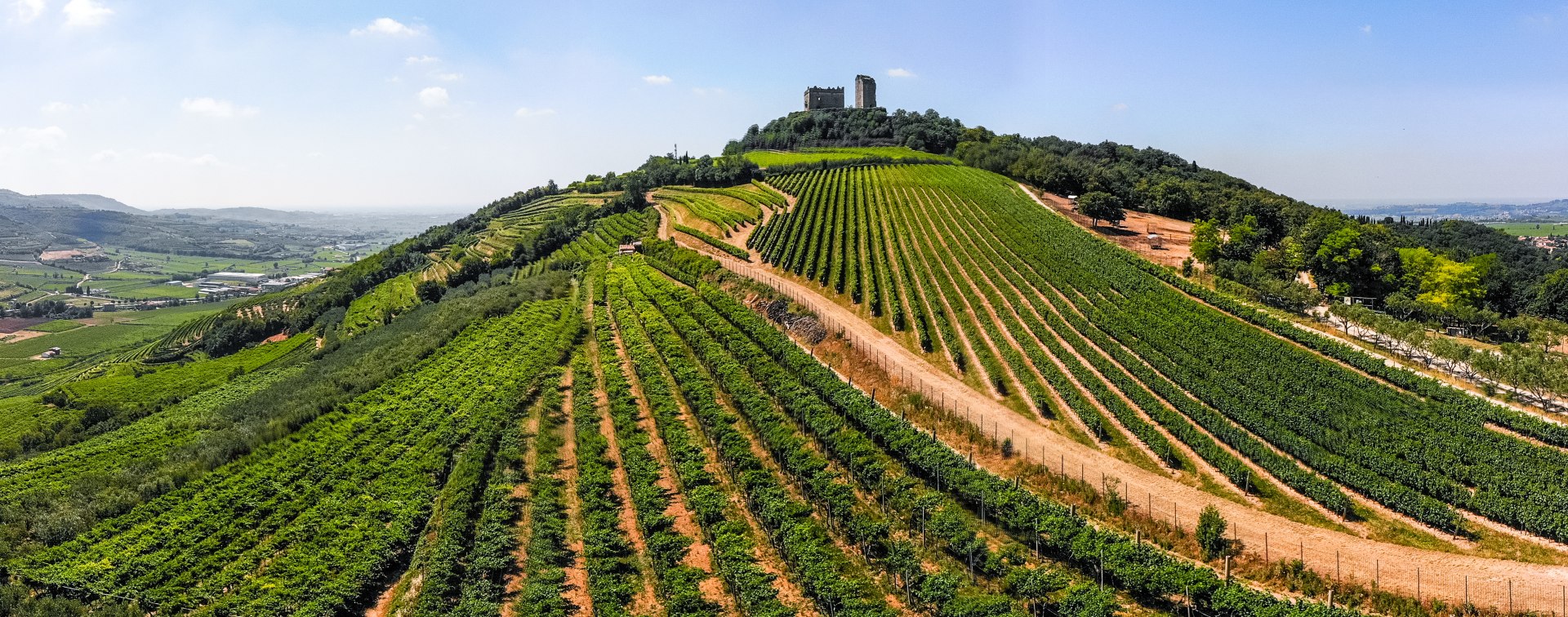
Wine is the result of a complex biological process that arises from the profound interaction between the vine and its environment. Despite being a unique genetic unit, the vine is deeply influenced by the places where it is planted.
—
This means that a type of wine such as Soave – although it possesses characteristics ascribable to an identifiable pattern – acquires an array of nuances that is as vast as the micro and macroclimatic traits of its territory.
This process, which we could define as epigenetic (which means that it is influenced by the environment), has occurred across the history of viticulture, specifically when the most suitable areas had been selected for the cultivation of certain varieties. And this distinctively takes place in Soave, a place where the volcanic soils show an astounding and intrinsic geological variety that leads to an equally extensive range of expressions.
Therefore, after decades of research on soils, climate, winemaking processes and the historical importance of Soave vineyards, the Consorzio has finally given life to the UGAs, or Unità Geografiche Aggiuntive (Additional Geographical Units) of the Soave denomination. These areas possess certain pedo-morphological and climatic characteristics that are identified in a series of well-defined vineyards and that give rise to peculiar wines, which are the reflection of those same characteristics.
THE ORIGIN OF THE UGA
Work for the identification of the UGAs began in 2000 thanks to the Consorzio. The project commenced with the publication of “Vigne del Soave” which contained a precise zoning of the area that allowed to identify the different soils as well as altitude, slopes, the effect of the Pergola Veronese on the Guyot system and many other fundamental analytical data. Naturally, the zonation proposed by “Vigne del Soave” was largely based on the age-old division of the area according to the name of the places: an ancient technique of dividing the vineyards in accordance with the experience and work of the people who have cultivated these lands for generations and denominated them.
Fun fact: only a few know that the project regarding the UGAs came before the famous MGAs – or Menzioni Geografiche Aggiuntive – of Barolo and Barbaresco, the equivalent of the UGAs in Langa. However, it was only in 2019 that the Wine Committee of the Ministry of Agricultural Policies finally approved the inclusion of the Unità Geografiche Aggiuntive in the Soave disciplinary. This provides that vinification must take place separately from other wines, thus ensuring traceability of the supply chain, a limited production and greater recognizability on the market.
THE UGA BY NUMBERS
Before the UGAs, the only existing distinction made was between the area of Soave and Soave Classico. This differentiation is not related to wine quality but assumes a more historical importance: the Classico area includes about 1,500 hectares of hills that have always been planted with vineyards in Soave; while the rest consists of around 6,000 hectares and represents the “newly” planted areas, including the plains.
The Unità Geografiche Aggiuntive cover both areas, enhancing the nuances of Soave in 33 different crus that incorporate around 7,000 hectares: 29 in the Classico area, 2 on the dark soils of Val d’Alpone and 3 on the limestone soils of the western valleys. The 33 UGAs enclose the 4 types of soil present in the territory: from the calcareous seabed of Mezzane, Val d’Illasi and Soave to the volcanic soils of Val d’Alpone. The UGAs only account for 38% of the vineyard area on the hills of Soave: Castelcerino, Tremenalto, Costalunga, Castellaro Costeggiola, Sengialta, Foscarino, Rugate, Monte Grande, Costalta, Pigno, Froscà, Tenda, Zoppega, Broia Monte di Colognola, Duello, Fittà, Corte, Durlo, Menini, Brognoligo, Campagnola, Colombara, Carbonare, Coste, Pressoni, Casarsa, Ponsara, Volpare, Croce, Ca’ del Vento and Paradiso Roncà – Monte Calvarina.
We should bear in mind that the UGAs are not a wine classification. Rather, they denote «propitious combinations of morphological, pedological and physiological features of a vineyard», as pointed by the Consorzio, «which guarantee the production of wines that have acquired distinctive enological traits». These peculiar characteristics are what each winery must bring out to become consistent with their area.
Therefore, the work of the people who cultivate and produce UGA wines will be the determining factor that will allow consumers to trace their personal map of Soave, nuance by nuance.
—