Volcanic terroirs are complex environments, whose generous and fertile land generate high-mineral products of exceptional flavour and surprising longevity
Complexity and longevity are without doubt the characteristics underpinning the PDOs promoted by the Heva – Volcanic Agriculture of Europe programme: Soave, Lessini Durello, Santorini and Monte Veronese, protected by the Italian Soave and Lessini Durello Wine Producers Association, the Greek Association Union of Santorini Cooperatives – Santo Wines and the Veneto Association for the protection of Monte Veronese cheese.
Intensity is certainly the word that best suits wines and products born from volcanic soils: their lingering flavour is never aggressive, while their ageing potential enhances both fragrance and structure. These characteristics stem from the action of lava on the soil over centuries, counteracting the latter’s mineral acidity and generating lands suitable for the production of high quality ingredients which, although belonging to different product categories (wines and dairy products), draw their strength from the local land.
The international project Heva – “Heroes of Europe: Volcanic Agriculture”, funded by the European Union within the framework of Regulation no. 1144, sets out to enhance and promote the unique characteristics of wines and dairy products whose distinctiveness is rooted in their volcanic soils.
Although volcanoes often bring to mind natural disasters and therefore can evoke negative feelings, wine-making offers a new perspective in the assessment of this kind of environment. They have always been one of the most precious examples of the dialectic between man and nature, and are characterised by exceptional soil fertility and generosity.
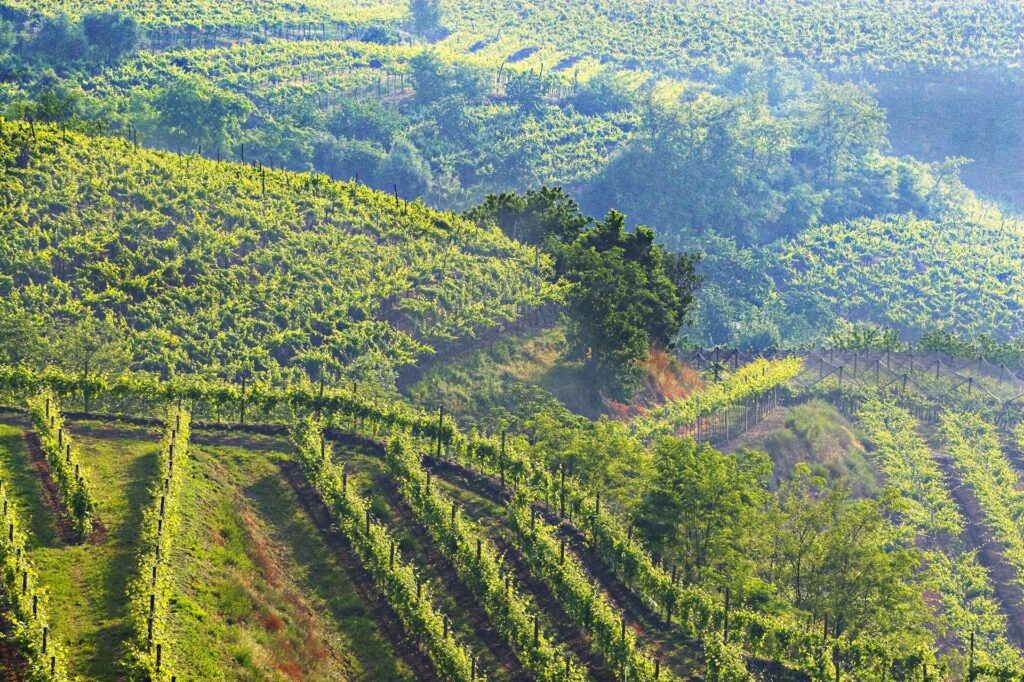
Composition and uniqueness of volcanic soil: from Soave to Lessinia
The soils that form as a result of eruptions and lava flows are extremely heterogeneous. Lava brings deep rocks to the surface that dissolve in basalts; over them lie many components of explosive origin, such as ash, lapilli and volcanic bombs (drops of molten rock ejected from the volcanic cone). Stratified pyroclastic materials can consolidate over time and give rise to so-called tuff, which in later stages of degradation gives rise to sandy, coarse soils, rich in mineral and skeletal elements. Volcanoes, on the other hand, consisting of cooled lava flows, have steeper slopes and give rise to dark, often superficial, clay-rich soils that slowly turn into agricultural soil.
Different terroirs that can stand even thousands of kilometres apart have developed the same propensity for quality, based on similar pedoclimatic factors, geological history, exposure and altimetry. These features are reflected in the PDOs originating in these areas and in their tendency towards lingering flavours, high-mineral contents, longevity and complex tastes and perfumes.
“The aim of HEVA – Heroes of Europe Volcanic Agriculture,” states the Chairman of the Soave Producers Association, Sandro Gini, “is to promote a culture of volcanic agriculture and to raise awareness among consumers of the features and uniqueness of all the products generated by these terroirs, as a result of the synergy created between soil, human action and time”.
The indisputable quality of wines and dairy products of volcanic origin is, in fact, also the fruit of the providential intervention of man, of which we can find virtuous examples both in Italy, in the Monti Lessini area, and on the Greek island of Santorini.
“In the area of Verona, the human factor has played an important role since very early times,” says Alfonso Albi, Chairman of the Producers Association for the Protection of Monte Veronese PDO Cheese. “Here, the expert, non-intensive cultivation of these soils has enabled redistribution of the most useful mineral components for plants, providing them with an ideal nutritional environment.
With its special characteristics, the Verona area is also particularly suitable for pasture, which has allowed us to develop a significant cheese-making tradition linked to the production of cow’s milk cheeses which in 1996 obtained the “Monte Veronese” PDO designation.”
Grazie alle sue peculiari caratteristiche, il territorio veronese è anche particolarmente adatto al pascolo e ciò ha permesso lo sviluppo di un’importante tradizione casearia legata alla produzione di formaggi vaccini che ha ottenuto nel 1996 la DOP con la denominazione “Monte Veronese”.

Santorini: The Thera explosion and 1,200 hectares of volcanic vineyards
Volcano soil can be extremely ancient, as in the cases of Soave and Lessinia, where the volcanoes became extinct between 25 and 50 million years ago. Or it may be more recent, as in Santorini, a Greek island in the Cyclades, in the Aegean Sea, which emerged some 2 million years ago, and currently rests on a lava crust resulting from the catastrophic volcanic eruption of Thera, which produced a 30m layer of lava rock, ash and pumice stone across the entire island between 1627 BC and 1600 BC. Its soil is made up of coarse sand, pumice stone, volcanic ash, and solidified lava rocks.
The lack of clay in the island’s sand-rich soil has made the vines immune to phylloxera, which is why the Santorini vineyards are among the oldest in the world. The island boasts 1,200 hectares of volcanic vineyards on a soil that also has another unique feature: it is poor in organic matter but rich in minerals, with the exception of potassium, with consequences for its chemical composition and resulting in Santorini’s PDO wines with a low pH. To safeguard, promote and protect these wines, the Union of Santorini Cooperatives – Santo Wines was established in 1947.